
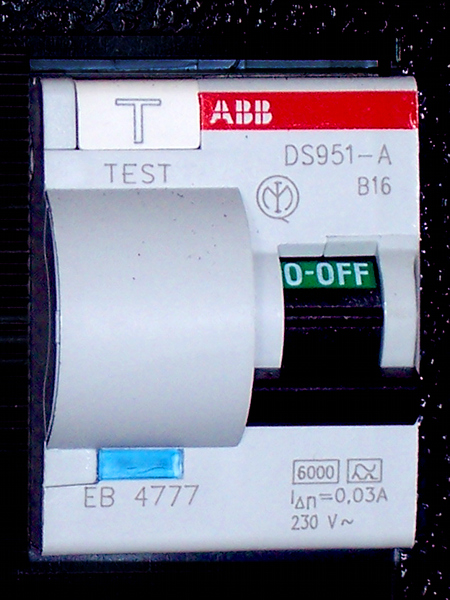
Jahoe · Public domain

A consumer-unit quotation can contain several similar abbreviations: RCD, RCBO and AFDD. They describe different protective functions, and some products combine more than one. They are not simply three grades of the same switch, with the longest name automatically being the best choice for every circuit.
Understanding the distinction helps explain a proposal. The actual selection still depends on the installation, the connected equipment and the requirements applying to the work.
RCD: residual-current protection
A residual current device responds to an imbalance between the currents in the conductors it monitors. It provides an important protective measure against certain electric-shock risks. It does not make electricity harmless or remove the need for a sound installation and effective earthing.
RCD is a general term. An RCCB is one familiar type, often protecting a group of circuits, but it does not itself provide protection against overloads and short circuits. Appropriate overcurrent protection is needed as well. This is why a board may have a larger RCD serving several smaller circuit breakers.
RCBO: two functions for a circuit
An RCBO combines residual-current protection with overcurrent protection. It can provide both functions for an individual circuit rather than having several circuits share the same residual-current device.
That can reduce the disruption when a fault trips a device. With a shared RCD, an issue on one circuit may also disconnect other circuits it protects. Individual RCBOs can keep that interruption more local, although a circuit may serve several rooms and other faults can still affect the wider supply. It is not a promise that only one room will ever lose power.
AFDD: looking for dangerous arcing
An arc fault detection device monitors electrical patterns associated with dangerous arcing and disconnects when the relevant fault is detected. Loose connections or damaged conductors can be involved in arc faults. This is a different function from responding to an ordinary overload or a residual-current imbalance.
Products can combine AFDD and RCBO functions. A quotation should make clear what is proposed for each circuit and why. Whether AFDD protection is required or recommended needs considering against the current requirements for that installation. An existing home should be assessed before deciding which changes are appropriate.
A trip is information worth investigating
If the current board trips repeatedly, describe when it happens and what was running. Does it coincide with one appliance, rain affecting outdoor equipment, or several loads being used together? You do not need to decide the cause, but a record of the circumstances helps the electrician investigate it.
Do not assume a protective device is faulty simply because it operates, or ask for a higher rating to stop the inconvenience. A device may be doing its job. Any proposed replacement must be suitable for the circuit, the consumer unit and the equipment supplied.
Compare the work as well as the hardware
Two prices for a new board may cover different investigations, repairs and protective arrangements. Ask what happens if testing identifies a problem on an existing circuit, and whether the quotation includes necessary earthing and bonding work, labelling and completion paperwork.
Tell the electrician about planned additions, such as an outbuilding or new equipment, before the design is agreed. At handover, ask for the circuit labels and relevant user-test instructions to be explained. Keep the certificate and product information where they can be found when the installation next needs attention.
Wallington Electrical Services can assess a proposed consumer-unit upgrade and explain the protection included in the quotation. A description of the property, any existing faults and the changes you have planned will be more useful than choosing a board solely from the number of devices shown in a photograph.