
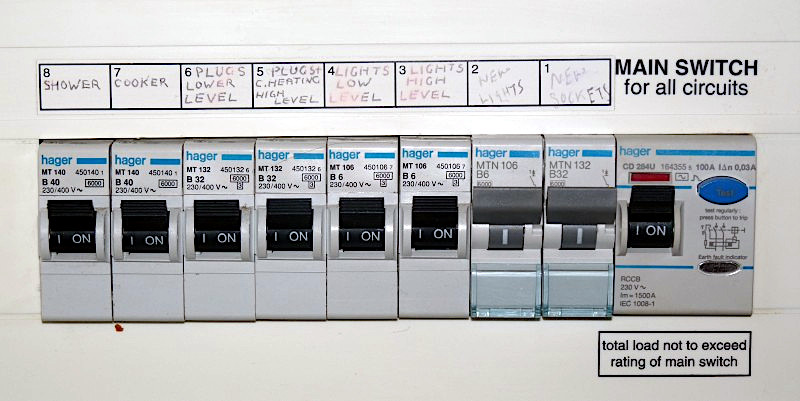
Pfnicholls; colour/sharpness revision by MikeRun · CC BY-SA 4.0

A consumer-unit replacement is more than exchanging one box for another. The electrician needs to understand the existing installation, choose an appropriate arrangement and verify the completed work. That is why a useful quotation should explain the assessment and testing as well as the equipment being fitted.
Start with why it is being changed
Perhaps a report has identified concerns, new work is planned or the existing equipment has become unsuitable. Tell the electrician the reason and provide any reports or certificates. A photograph can help an initial conversation, but it cannot establish the condition of all the connected circuits.
Avoid assuming that a new unit renews the wiring throughout the house. Existing circuits may remain, subject to assessment and the agreed work. Ask what the replacement is intended to improve and what it will not change.
Expect questions about the installation
Access, circuit identification, earthing arrangements and previous alterations can affect the job. The installer needs to assess the relevant conditions rather than choose equipment solely from the number of switches in the old enclosure.
Discuss any future projects, such as a kitchen, extension or vehicle charger. This does not mean every possible addition must be installed now, but it helps avoid making decisions without knowing the likely direction of the property. Future capacity and arrangements still need proper design.
Understand the quotation's assumptions
Ask what inspection and testing are included and how defects discovered during the work will be handled. Some problems may need correction before the installation can be completed as intended. The quotation should explain the process for additional work rather than leave you expecting an unconditional fixed outcome from limited information.
Product selection should follow the installation requirements. If protective devices or other components are listed, ask for an explanation of their purpose in plain English. You do not need to become a designer, but you should understand why the proposed arrangement suits the work.
Prepare for the day
Find out what access is needed and how power interruptions will be managed. Mention home working, alarms, heating controls and any essential equipment in advance. Clear the working area as agreed; a consumer unit behind a cupboard full of belongings is not ready access.
Do not assume that everything will be back on at a particular time without an agreed programme. Testing and unexpected findings can affect the sequence. Ask how you will be kept informed and what happens if further work is required.
Keep the handover documents
The completed work should come with the appropriate electrical certification and any required Building Regulations compliance process for the project. Agree who handles this and retain the documents with the property records. Ask to be shown the labelling and the manufacturer's user instructions for relevant controls and testing.
Decide what to do if testing reveals a problem
Ask in advance how findings will be explained, recorded and priced. There may be a difference between a small issue that can be resolved within the agreed scope and work requiring a separate decision. You should know how authorisation will be obtained and what the safe interim arrangement would be if the work cannot be finished immediately.
This is also a reason to allow suitable access to the property. Testing can involve points away from the consumer unit, so the job should not be planned as though the electrician only needs the cupboard containing it. Ask which rooms and equipment need access before the appointment.
Wallington Electrical Services can explain the proposed replacement and the condition-related work separately. If decoration or joinery around the unit is planned, coordinate access and finish details before starting. A tidy new enclosure is welcome, but the important result is a properly assessed, installed and documented arrangement, with no confusion about the parts of the house that remain unchanged.